To be is to make oneself one at one's own expense
Why a stone is one thing and a heap of sand is not (and why two glued-together people remain two)
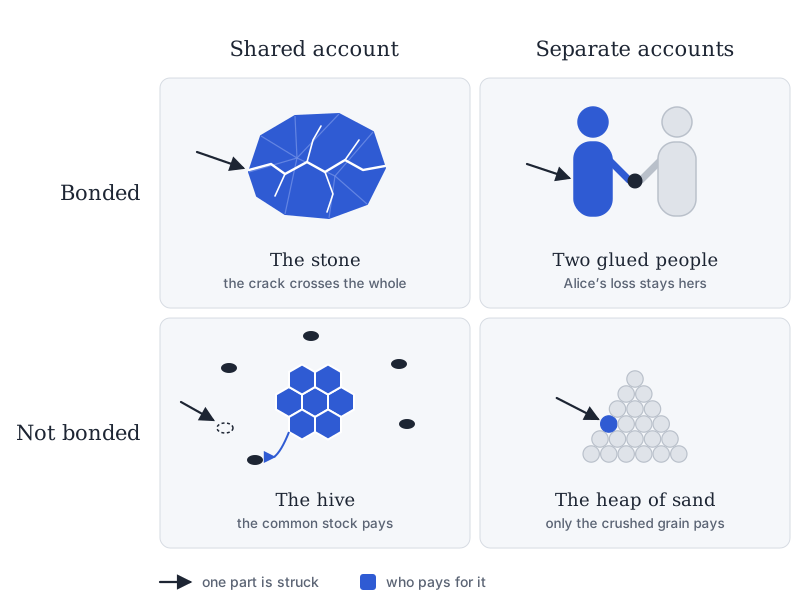
TL;DR — To be a thing is to make oneself one at one’s own expense. To find out whether some parts form a single thing, don’t ask whether they hold together. Ask who pays when one of them takes more than it can bear.
Take a stone. It is one thing. Now take a heap of sand: we say “a heap”, but we sense that it is rather a lot of grains resting on one another. What makes the difference?
The question sounds silly. Yet it is one of the oldest in philosophy. In contemporary metaphysics it is known as the Special Composition Question: when do several things together compose one thing? The usual answers all get stuck somewhere.
The usual answers
First answer: a thing is one because it has a form, an essence, a nature. The trouble is that this does not say how to recognise that form. Saying “the stone is one because it has the form of a stone” is answering the question with the question.
Second answer: everything is process, flux, change; a thing is a stable flux. Fine, but then a whirlpool in a river is a thing just as much as a living cell. Both keep their shape while their matter is entirely renewed. Yet we sense that they are not one in the same way, and this answer cannot say why.
Third answer, the most modern: a thing is one when its parts are physically bonded. The atoms of a stone are bonded, the grains of a heap are not. This works well, until you superglue two people together by the hand. They are bonded. Do they thereby form a new thing, “Alice-and-Beatrice”? Almost no one thinks so. Worse: a gecko stuck to a window would form a “gecko-window” object.
Peter van Inwagen used cases of this kind (Material Beings, 1990) to reject answers in terms of contact and bonding. His own answer is radical: only living things compose anything. For him there are no stones at all, only particles arranged stone-wise.
Another idea: to be is to make oneself one at one’s own expense
The sentence says two things.
First, unity is not given, it is made. Nothing is one “all by itself”, as though by default. Even a stone holds: its atoms stay together against a world that wears them down (erosion, impacts, heat). A thing that holds is a thing that does something, however little.
Second, it costs, and the cost falls on someone. Holding wears out. And the decisive question becomes: on whom does the loss fall?
The test: strike one part, and watch who pays
Strike one part harder than it can take on its own, then watch where the excess goes.
- The stone. Strike one grain too hard: the crack propagates and consumes the cohesion of the whole stone. The stone pays. It is one.
- The heap of sand. Crush one grain: the grain pays, and that is about all. Even when the heap collapses, each sliding grain spends its own energy: it is a cascade of separate payments, not a common payment. The heap is not one, or barely.
- The two glued-together people. If Alice’s liver fails, nothing she shares with Beatrice pays anything at all: neither Beatrice nor the glue. They are bonded, but each takes her losses alone. They remain two.
- The bee colony. This is the reverse case, and the most interesting one. The bees are glued to nothing. Yet when a forager dies, the others raise a replacement with the honey they produced and stored together. The loss is paid out of a common stock. The colony is one, even without physical bonds.
That is what makes the idea interesting: it is not the same thing as being “bonded”. Bonded things can keep separate accounts (the glue), and unbonded things can share an account (the hive).
A caution: “at one’s own expense” does not mean “with one’s own resources”. You eat what you did not produce, a plant lives on the sun, no one feeds on themselves. To be one at one’s own expense is not to be self-sufficient: it is to be the one on whom the losses fall. The account is not the wallet.
Second question: being one, and being a self
A stone is a thing, but it is not a “self”: nothing in it repairs anything. Hence a second question, asked in the same register: who refills what has been spent?
- For the stone, no one. It wears out and that is all.
- For the whirlpool, the river. It does not remake itself: it is remade by another.
- For the flame, itself: its heat sustains the combustion that produces its heat. But it has only one “dial”, and nothing else it makes adjusts that dial.
- For the organism, itself as well, but with tools it makes itself (enzymes, membranes), and which make one another.
Only the organism is a self in the strong sense. The stone, the whirlpool and the flame are things, each one in its own way, but none of them remakes itself completely.
Two surprising consequences
The corpse. When an animal dies, what remains? Some philosophers say that a new object appears, the corpse, exactly where the animal was, which is odd. (This is discussed in the literature on animalism as the “corpse problem”; see Olson 2004.) Here the answer is simple: at death, nothing remakes the body any more, so it is no longer a self. But its tissues still hold together and still pay together for what happens to them: it is still a thing, the same one. No object appears. The corpse stops being a thing only when it decomposes.
The tardigrade. This tiny animal can dry out completely and spend years without metabolism, then come back to life when moistened. Take two dried tardigrades: one will be able to revive, the other is damaged and will not. A classical ontology would say that the first is “a tardigrade on pause” and the second “tardigrade remains”. Here, no: the two hold together in exactly the same way. They differ in what they can become, not in what they are. Being a self is a regime one can leave and resume, not a label one wears.
Objections and replies
1. “Your test just detects cohesion. The real criterion is bonding.” The two come apart in both directions. The glued people are bonded but keep separate accounts: Alice’s liver failure costs Beatrice nothing. The bee colony has no bonds but a shared account: a dead forager is replaced out of the common stock. If shared loss were only a symptom of bonding, neither case could happen.
2. “This is van Inwagen’s question, and he already answered it: only lives compose.” The two criteria agree on the glued people and disagree on the stone. For van Inwagen a stone is not one thing, since nothing in it is alive. Here it is one, since a blow to one part is paid by the whole. I would say his answer merges two questions: what makes something one, and what makes it a self. Life is the right answer to the second, not to the first.
3. “‘Who pays’ is a metaphor. Outside physics, it is up to the observer.” It is a counterfactual about where a loss goes: intervene on one part, and see what else is drawn down. For inert matter, physics answers (fracture propagation, binding energy). For organisms and colonies, the answer is the stock the loss is paid from: reserves, tissues, stored honey. Finding it takes work, case by case, but it does not depend on how we choose to describe things.
4. “The verdicts are strange: a hive is one being, and a device with fuses is several things.” Both are accepted. The first is less strange than it sounds: biologists already treat eusocial colonies as organism-like (Hölldobler & Wilson 2009; Queller & Strassmann 2009). The second is exactly what engineers intend: fuses and independent modules exist so that a failure stays where it happens, to limit its “blast radius”. A design that keeps losses local is a design for several things.
5. “What about conjoined twins who share a circulation?” The criterion does not decide “one or two” by fiat: it says where the accounts are shared. A haemorrhage in one draws on the blood of both, so at that level there is a single account. They are partly one organism, and still two people. A mixed answer is what we should expect here, and it matches how hard these cases are, medically and ethically.
6. “The whole idea assumes that holding always costs something.” It does, and in our world, where nothing is perfectly reversible, that is true. In a world without wear, nothing would be one in this sense. That is a consequence rather than an objection: on this view, unity is a feature of worlds where things wear out.
References
- Hölldobler, B. & Wilson, E. O. (2009). The Superorganism. W. W. Norton.
- Olson, E. T. (2004). Animalism and the corpse problem. Australasian Journal of Philosophy, 82(2), 265–274.
- Queller, D. C. & Strassmann, J. E. (2009). Beyond society: the evolution of organismality. Philosophical Transactions of the Royal Society B, 364(1533), 3143–3155.
- van Inwagen, P. (1990). Material Beings. Cornell University Press.